Wednesday, May 18, 2011

POST NINE: The Double Cardigan.


On the bottom hangs the first cardigan, right-way up. The threshold of the neck points above. The limit of it’s waist pointing down below. It is the garment in it’s everyday, the placement wearing habitually practice, overlooked and assumed. Above is the hanging environment of the cardigan. It is flipped, mirroring the lower garment. It has been turned on it’s head, or should I say it’s neck. It’s waist pointing upwards to the sky. It’s usual construction of dressing has been interrupted. It is mid-way through somersault, atypical, unfamiliar and jarring.


I attempt to ‘put on’ and dress myself in the cardigan. I open its sides and first see the horizon of the neck, separating cardigan embodied from cardigan experienced. I reach for the first sleeve, one of four. I take the lower left sleeve and pull my arm through. Already I am struck by the extend of this garment, my head it not free, my field of vision will become dressed to.


I turn and reach for the other sleeve, and pull through my right arm. The cardigan is now on my back, to a greater extend than usual. I feel as though it’s spongey, knitted texture is standing behind me, following me, looking over my shoulder. The cardigan has my back, including the back of my head.


I go to button up my front starting at the bottom. Button one, it tightens over my hips. Button two closes echoing the button of my belly. Button three, bust in. Button four neckline em-bound. Button five, a repeated neck. Button six, the first time my lips have worn without cosmetics. Button seven dresses my eyesight. Button eight completes the construction of this personal space.


I am now wearing the garment in its whole. My body is dressed in the usual ways, and new unusual. When I look around the inside of the cardigan, I can experience it’s space in a new way. Instead of coming to know it through an established experience of it’s touch against my torso, with my sight resting on its outside, these sensations are now flipped. I can presently view the usual space of embodiment with my eyes registering it’s inside. I reach up to put my hands in the upper cardigans pockets. I see the impression of my hand pushing through to the pocket walls. Touch is now applied to the cardigans outside.


The flipped cardigans arms hang down like rabbit ears. I can feel them resting about my shoulders, like a dangling hug or as if trying to do hand stand. They imply an previous direction of embodiment.


Wearing the double cardigan and meditating on it’s experience explain a few things to me. It explains to me the making of the sixth sense - wearing. Wearing is mainly comprised of sight, touch and the way in which these two communicate with each other to create a dialogue/feeling of positioning. I am highly aware of the space I am wearing in the double cardigan. I am visually aware of the space around my sight in the upper cardigan, which I know is simultaneously felt as touch against my body in the lower cardigan. I am seeing and and touching the act of dress at the same time. My sight has form and my touch has eyes. I have a new sense of self framed by the wearing of the double cardigan and the experience of its embodiment. I have put on a double cardigan, wearing a garment and an environment.


POST EIGHT: IMAGE - LEE MILLER


This is an image of a cardigan upside down. I like it. The garment is flipped. When I look at it i don’t directly associate it with wearing, but more filling. In changing the placement of the cardigan, space is abstracted and the possible use changes.


POST SEVEN: PATTERN MAKING ASSUMED SPACE OF SHORTS

In an initial attempt to pattern make the worn space of a garment I have started with a pair of short, which I arranged on the floor mimicking a disregarded throw. They looked like they might when you quickly whip off your pants in your room and leave on the floor when you are changing your clothes quickly or running late. They become disregarded. There deflation changes the space they take up and changes beyond assumptions. They had the memory of wearing in them indicating a previous embodiment.


I drew the shorts creating something in between a line sketch of the garment and a potential draft. The shapes where traced into pattern pieces, cut, constructed and sewn creating a flat pair of shorts.


I was trying to pattern make the shorts on the x axis, but what I have more so done is pattern make a mostly flat image of the shorts.


I like how potentially a person could mistake them for a pair of shorts chucked on the ground. They may go to pick them up expecting the legs and greater form to drop thorough as they lift the garment, thus realising the actual construction of them when this does not follow through. I do like how the act of previous wearing can be documented through a flat pattern.


Wednesday, May 4, 2011


POST SIX: A SHADED VIEW

"Dianne Pernet invites you to contribute to her blog A Shaded View of Fashion. What do you do?"

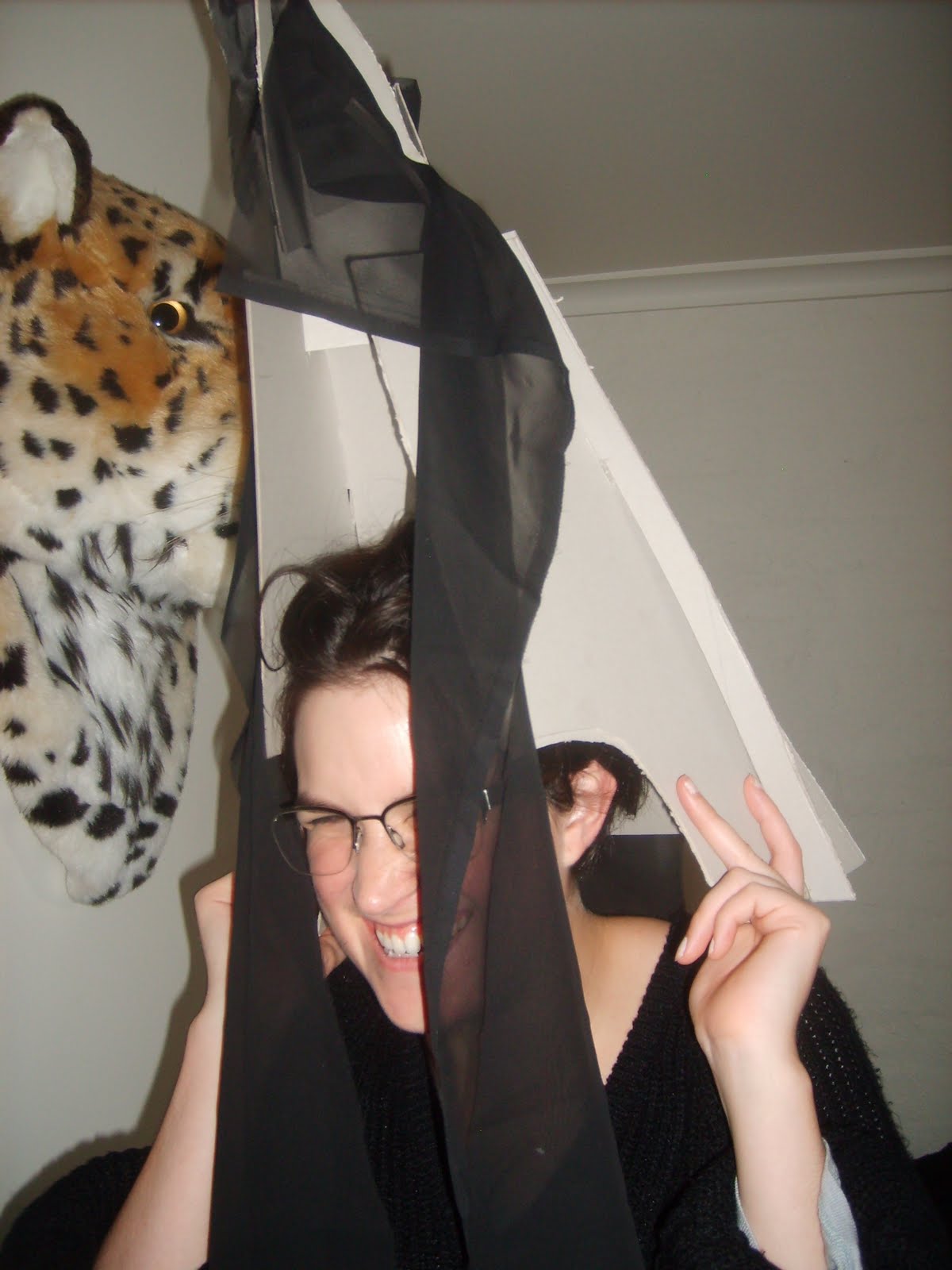
I always find how Dianne Perent only wears her black veil outfit, intriguing. Can I pattern-make her veil using the SCRAP - Slit/Slip system? In response to this task I put the outcomes in the context of the blogs initial "Pop Up" and the "Logo", which are both images of Dianne. Images below:


POST FIVE: SCRAP CONEXT

Looking at the 'Scrap' piece in different contexts brings new meanings and developments.

Scrap in the art gallery. Here a folded permutation of scrap is in a gallery space. This is how I imagine it being shown at the moment, though maybe it has existed in previous settings which are re-told at the gallery. The context of the art gallery, is not unlike the context of a garment, as both are places which are a designed environments. In reduction they are also both enclosed spaces although implying different level of scale and social use. I think if I place worn environments within the public environment of a gallery, the transition from personal to public space will be confronted.
Scrap in the cardboard recycling. This is a context relates to the material the object is produced from. As it's made of cardboard, it fits in the package recycling box. I like the idea that a cardboard box can be designed. I like that the use of something which is used as packaging could be applied to the contents. For example if the box folded out to a pattern piece, which was then used to trace onto the required fabric contained in the box.

Scrap as a fence. Scrap in the context of a fence gives it a feeling of borderline, which in a way is what a pattern piece is, or has the intention of being. This also reminds me of earlier images I was looking at in the development and research for Scrap, of works by RON RESCH. Particular a piece where he used his folded paper as an acoustic panel. Pattern Pieces could be used first as a pattern and then slotted together to create an acoustic wall.


Scrap in the garden. I love this one. Cardboard Planters. Pattern Cards having a second use as a decomposable and modular system of potting and growing plants. The slits have a good effect here.


Scrap in Ikea. Here Scrap becomes a flat-pac. It's place denotes ideas surrounding its accessibility and dissemination.


POST FOUR: CONTEXT

THESAURUS
  • conditions, factors, state of affairs, situation, scene, frame of reference, relationship to themes of setting.


DICTIONARY

  • the circumstances that form the setting for an event, statement, or idea, and in terms of which it can be fully understood and assessed.
  • the parts of something that immediately precede and follow something and clarify its meaning
THOUGHTS
  • Context is the circumstances of setting of a thing (object, event, idea etc.) which impact on how the thing is understood and assesses. Context is the surrounds of the thing which bring to it all its associations, and meanings. Everything exists in a context as existence happens in space and time.
  • In some ways I hope my work has as little extraneous context as possible, I hope it’s frame of reference is only in the experience of it, in itself. But then by trying to do this, I know I have just loaded it with massive amounts of conditions which in relationship contextualize this aim.
  • Some points areas of context I would like to look at include, experience, documentation and space

PHOTOS OF MY BRA IN DIFFERENT CONTEXTS


Gives the tree a personality and extra support


a total larry


Gives the bra a sordid teenage setting


thirsty bra


reminds my of henry the eighth

Wednesday, April 27, 2011


POST THREE - QUESTIONS:

My initial questions, and the following breakdowns:
  • How do you document worn fashion space
  • How do you make a person question where space is that they wear
  • How does the boundary of a pattern relate to the negative space of the world and the positive space of wearing or vice versa or each other?
  • How do you construct the notion of self, with the design and wearing of a space?
  • Where does wearing finish in the space of a garment?
  • Where does the boundary of embodiment end in the act of wearing?
  • How do you wear an environment?
  • Can an environment be fashion?