Thursday, April 15, 2010


Proposal for Fourth Year Project


aWEARness


CONCEPT

Fashion as a garment or a space is most intimately experienced through subjective wearing. Wearing is a peculiar enigma, reliant on experiencing space and the way in which it takes scope through its construction and boundaries. A person’s consciousness is commonly accepted to lie inside their body. Can a consciousness fill a garment, or transcend through a garment? One can say that “Dress lies at the margins of the body and marks the boundary between self and other, individual and society. This boundary is intimate and personal since our dress forms the visible envelop of the self and serves as a visual metaphor for identity.” (Entwistle, J. 2001) The phenomena of being and wearing bring up dualistic notions of form and consciousness; the imagined body / physical body, conscious being / corporeal being, interior self / exterior display, self / otherness. Can a fashion garment possibly reconcile or link these opposites?


AIM

I would like to investigate and explore the way a worn/experienced fashion space is determined through an idea of consciousness relating to body dualities. Fashion is based in space, a space which is worn/experienced. Wearing echoes embodiment as being encased in wearing. I plan to interrogate how and where consciousness and space meet in fashion? How is the space of a garment/instillation determined through an idea of consciousness around the body? How far does this consciousness diffuse and where is it lost? How does a garment reconcile dualities in the body and being through the wearing of a constructed space? How can the intimate practice of this enigma be shown?


RESEARCH

My research has been based (thus far) in the writing of the Poetics of Space by Gaston Bachelard , The Fold by Giles Deleuze and also concepts of philosophers and fashion theorists placing their work in the understandings of phenomenology, namely those of Joanne Entwistle, Susanne Kozel and Maurice Merleau-Ponty.


Drapery and in essence, its foldings, construct and hold space in a dynamic way that displays surface and depth, inside and outside, worn and shown. Folds are... “ transformations [which] convey the projection, on external space, of internal spaces defined by ‘hidden parameters’ and variables or singularities of potention” (Deleuze, G. 1993) Drapery shows the frictions and forces of wearing and looking. Why is folding a means of construction which seems to show dualities? Can the physical body transcend through drapery?

Other initial research areas have included the object of a curtain and its use in fashion precedents. The curtain is an expanse of material which acts as a border, much like a garment, experienced from point of view and display. It is an object based in foldings and drapery. In the context of Deleuze I have been looking at drapery as a metaphor for when two separates are one. Drapery is also an a construction method and surface, which can be read in the context of baroque statues and antiquity. Draping is a dynamic way of showing surface and depth, inside and outside, whats worn and whats shown in a garment.


Phenomenology can be used in looking at effective ways in exhibiting an experience. In essence it is "relate[ing] to how the act of hyper-reflection, where concepts begin to be elaborated in and through experience, is materialised into form. " (Kosel, S. 2007) How can phenomenology be applied in disseminating the experience of wear?


METHODS/APPROACH (tests and exploration)

Methods will entail a interrogative and explorative use of drapery. Research will be taken into forms that use drapery and fashion precedents that use these forms. Can drapery be constructed or systemized? How does one construct drape in pattern-making and can be commercially disseminated through pattern? Further exploration into devices that connect to the use of a fold and how these delineate space will be undertaken. How does unbroken expanse of textile form drape and how can this be organised to show body dualities and an objective sense or experience of embodiment?

I will also investigate ways of disseminating a fashion experience in ways other than form. Most probably through instruction or numbers. This brings up the notion of grading as a generative tool. Grading is a commercial fashion system which uses equations of space proportion to iterate a breadth of sizes. It is a way of controlling measurement of space for the appropriate form. Can a system of disproportionate grading inform the use of measurement, thus space in the design and construction of the collection? What size is my consciousness? How is the capacity of a consciousness held in a garment?

The use of drape implies a state of flux and a type of random, opportunistic behavior. This gives way to looking at the way interpretation of a garment takes place through wearing. Can a collection of garments heighten their wearers sense of awareness through subjective interpretation by the wearer or perhaps by a type of interrogation in the process of getting dressed.


Exploration into construction and design methods will be echoed with exploration into their display in an installation context. I will undertake testing into how a sense of intimacy and subjectivity is achieved through the wearing and display of space and how this transition from subjective to objective takes place.

Self reflection in wearing is an idea that interests me, and this happens in the process of getting dressed and also in the space of the change-room. The change room is an intimate place where the wearer is alone with their image pondering the phenomena of the garment abound their being. I would like to research the way this consciousness is created and if it can be revealed or shown. Can the space of wearing be shown through something other than the fabric of a garment? Perhaps a type of projection of imagery? Can you wear a consciousness?


DOCUMENTATION

The recordings and developments of my thoughts at their roughest and most preliminary phase will be recorded in a series of A5 journals. Weekly posts on my blog will show images, clips and texts which inform and document my development.

I will also document my process through the development of toiles, photographs and sketches of a more polished format collated in a A3 format with the inclusion of 3D patterns. I will undertake a series of tests in formats of display and dissemination of my work and possibly film these experiences. Film and projection is something I would like to further explore in an instillation, adding to the display of surface and depth.


OUTCOMES (experience and dissemination)

The collection will take form in a collection, most probably a series of garments. The garments may be experienced somewhere between and incorporating both objective viewing and personal wearing. How you integrate these two opposites in dissemination being a main concern of the project. How do you display garments in a way when viewed and worn give a heightened sense of the way a garment takes up space around a body and in the greater space of a room? Any extraneous communication other than garments or display which may photography, film, or catalogue will be used in way to further communicate ideas of phenomenological wearing.

In essence I hope the garments further communicate a sense of wearing to their viewers and the type of self-reflection and awearness that comes with wearing. This may be done through a type of participation from the viewer in wearing, of a garment, of a space, or a consciousness.


Sunday, April 11, 2010


“Dress lies at the margins of the body and marks the boundary between self and other, individual and society. This boundary is intimate and personal since our dress forms the visible envelop of the self and serves as a visual metaphor for identity”

- (Entwistle, J. 2001)


Friday, April 9, 2010


WEAR am I WHEREING?


On the left is the baroque sculpture St. Cecilia - (Stefano Maderno 1600, Marble length 102cm.) On the right id the dialogue she may be having with the garment of folded fabric over her body and face.

St. Cecilia: Wear am I whereing?
Folds: Where are you wearing?
St. Cecilia: Yes, where is it that I wear?
Folds: Wherein I wear!
St. Cecilia: What about whereout you wear?
Folds: Where is that exactly?
St. Cecilia :Wear is that exactly !
Folds: exactly, wear is where ?!
St Cecilia: where is wear?
Folds: Wear is where you wear!
St Cecilia: Yes, but where is that?
Folds: I just told you, wear is where you are whereing?!

Wearing is asking where you conscious space lies? Wearing might be a process of constant questioning? How can I create garments or a pattern system that questions its wearer? Why do folds ask so many questions? Can drapery be systemised or is it always in interpretational flux?

Sunday, April 4, 2010


Draped Drapes


In initial development of my studio work I have been looking for a 3D object to use, which encapsulates the themes of my research thus far. Primarily the texts which have spoken to me the most have included The Poetics of Space by Gaston Bachelard, The Fold by Giles Deleuse and parts from both The Visible and the Invisible and Phenomenology of Perception by Maurice Merleau-Ponty. I think what im looking at is the way a fashion space is determined through an idea of consciousness around the body, in some ways fererring to it's dualities. The fashion space Im looking at is one based in experience, the space of the wearer and the place in which the wearer experiences. This brings up many dualities including the conciouss body/the physical body, subjective/objective, inside/outside, visible/invisible, materiality/metaphore. I want to explore how a fashion garment and the wearing or experience of that garment links, overcomes, intergrates these opposites.


The object which I first found useful in displaying these ideas was a curtain. A Curtin is something which in function reveals what we can see and hides what we cannot see, blocks and facilitates, it allows physical conclusions and an infinity of wonderings. It is physical, yet also in some ways elastic. It extends and compresses. It is a boundry line between two sides which has the ability to both seperate and join. It is a flat 2D form which becomes three dimensional in through folds and drapery. It is an expanse of fabric which acts as border and sets a perimiter. Its experience is very much based on point of view, from which side of the curtain you stand. It is made up of and interley based on the function of a fold. The curtain has, "transformations [which] convey the projection, on external space, of internal spaces defined by 'hidden parameters' and variables or singularities of potention" (Deleuses 1993:16). The boundries of body concious shift, and change through the amiguous space of wearing, much like that of a curtain.


As Delueze states, "According to Lebeniz, two parts of really destinct matter [perhaps one side of the curtain and the other side of the curtain, or on the side of body experience and the side of otherness] can be inseperable, as shown not only by the action of surrounding forces that determine the curvilinear movement of the body but also the pressure of surrounding forces that determine its hardness (coherence, cohesion) or the inseparability of its parts. Thus it must be stated that the body has a degree of hardness as well as a degreee of fluidity, or that it is essentially elastic, the elstic force of bodies being the expression of the active compressive force exerted on matter." The body much like the fold holds a fluidity, a kind of will to trancend much like "the folds in the soul", but also has a hardness, an amassed matter much like "the pleates of the matter." The 'fold' of bodily experience is reiterated in the 'fold' of wearing. Again this 'fold' of experience if found in the 'fold' of the curtain.


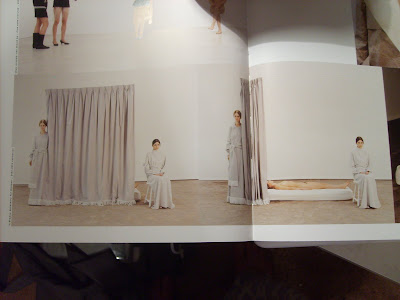
In looking at curtains, a number of practitioners, have used this in the past as form, metaphore and something in between. Cosmic Wonders 2002 garment/installation collection ‘A Shadow Necessary for Window” shows a dress take a surreal type of emergence from a curtain with a figure placed in its form. The expanse of curtain is then pulled across to show a naked figure lying on a mattress. The peice expresses a type of intimacy of domestic habitat and clothed habitat. The connection of dressed body and naked body through the curtain creates an aesthetic of protection, and cover.


The Curtain is used by MATERIALBYPRODUCT in a number of deviceful and allegorical ways. MBP descibe thier series of curtains as an “ambiguous moment” in thier initial creative generation. Often first rendered as a type of printed screen, they give rise to the fabrication and sense of surface of the immenent collection. The curtain also refers to a sense of antiquity, as they describe, “a period when the same piece of cloth could be worn as a draped garment, used as a blanket to sleep under at night, or hung as a curtain or partition.” This giving a sense of how garment and interior overlap in shared function and form. A garment is an interior and an interoir is worn. Furthermore the curtain as used by MBP takes on a modtuar outcome, highlighting a construction between dape and cut - this most prominent in thier SS09 collection in which the ‘block out finish’ of the curtain material used, doubled in funtion allowing internal and raw cuts.


Shigeru Ban Architects in 1993 created the Curtain Wall House. This building uses conventional domestic drapery and transforms it into the exterior of a building. The curtain wall functions in changing the experience of interior/exterior conditions by its opening the closing. It sheds the curtain in a light of protection, covering and shelter in an infrastructure-type way.


To me the curtain is the possibility and threshold to connection, and within this having the ability to change the degree of which that connection is shown. It stops and allows a line of sight and a line of experience. It is also a surface. It delineates the space of view/experience. It is a piece of fabric. It's what a mum's skirt looks like from the inside when a child hides between under he legs and looks outward. Its what conceals a change-room, the change-room curtain, where I experience wear. Within its folds are pockets of intimacy, covering and space for reflection. Below are some pics of experiments I have been doing with curtains;


Sunday, March 28, 2010


"That is why the lower depths of the monad are so dark. Since it does not exist outside the monads that convey it, the world is included in each one of the form of perceptions or 'representatives,' present and infinitely minute elements. Still again, since the monad does not exist outside of other monads, these are minute perceptions lacing an object, that is hallucinatory microperceptions. The worlds exists only in its representatives as long as they are included in each monad.


... It is a lapping of waves, a rumour, a fog, or a mass of dancing particles of dust. It is a state of death or catalepsy, of sleep drowsiness or of numbness. It is as if the depths of every monad were made from an infinity of tiny folds (inflections) endlessly furling and unfurling in every direction, so that the monad's spontaneity resembles that of agitated sleepers who twist and turn on thier mattresses."

*quote from - Deleuze 1993, The Fold, chapter: Perception in the Folds, pg 98.

Friday, March 26, 2010


Putting the ...Um? in Tri...um?ph

In reflecting on Triumph, I think it has been a good generative exercise to initiate studio work early in the semester. A "showpiece" is not something I would usually embrace and therefore throughout the design process I often found myself being critical about what I was producing being able to fit into this context. This is also good in some ways, as I guess the constant emphasis on "how your work being displayed/experienced informing its content" is sinking in and now second nature.

In approaching the Triumph brief initially, I broke-down their explanation blurb on "Shape Sensation." I interpreted the notion of SENSATION in relation to wearing as a type of self-concious corporeal body. I then tried to look at how this is shown through SHAPE in terms of build, configuration and construction. Overall I aimed to used methods of refiguring and deforming to show an interplay between the body shape and the ideal shape, the physical body and the aspirational body, corporeal space and physical space.

I looked at images of plastic surgery - which is I guess literal body reformation. I also looked at a few surrealist images using displacement including Hans Bellmer's deformed "Die Puppe" dolls and also Man Ray's "The Enigma of Isidore Ducasse". My process involved taking apart bras, displacing and bulding them on the manequin, then overlaying these forms with knit which was darted, folded etc. I tried to make use of a construction method in which the underlayed fabric of a dart is extended beyond the underwire point to further the fabric and form body covering, thus a fold being exposed - hopefulling revealing a type of inside/outside. This kind of worked, but I didn't really make the fold edges very clear in my technicals. I also tried to displace underwires to other parts of the body to show a non-traditional sense of border, 'support' and definition


The use of some type of folding showing a duality in form is something I would like to continue in my studio work.

Sunday, March 21, 2010


DAI FUJUWARA Lecture - The Endless Garment


The lecture by Dia Fujuwara was last wednesday evening as part of the Endless Garment Exhibition, was wonderful. Very engaging and inspirational, I feel very lucky to have been given first hand insights into the Issey Miyake design studio and the processes of designing and creating that they use. I have also developed a small crush on Mr Fujuwara.


I thought it was interesting and apt that one of the first things that Fujuwara said in the lecture was to state that A-POC was “not clothes, not object, it’s a solution of design.” This reiterates that if you are a concept driven designer, a ‘solution’ is the main outcome searched for, before (and if) it translates to something worn. After hearing Fujuwara talk it is obvious to see jut how strong the Miyake studio is in having their own type of studio-language. They know their methods and their approach to process so well, this leading to collections and solutions which are given their own autonomous philosophies, communicative structures and design languages. For example the way in which A-POC uses the four acronyms as its main essences of crux;


A-POC (a piece of cloth)

A-POS (a piece of string)

A-POM (a piece of machinery)

A-POE (a piece of education)


The design of how their solutions are communicated, is just as strong at the solutions themselves. See nifty clip (http://www.youtube.com/watch?v=x4_mK9CebB4)


The process and rigor through which the studio works is something to note. Fujuwara said that if the concept or garment needs more then 3 toiles or 45 meters of fabric and still doesn't work, then it is lost ... “it must perform.” It must but hard at times to have this rule of self-editing. Its was also interesting (and often humorous) to see some of the experiments used as design and concept generation, in their process. For example the miniature catwalk in a bottle being sucked away by the vacuum - “vacuuming fashion”. The painstaking hours of colour matching swatches for the ‘Colour Hunting’ collection. I also really liked the image of the development for catwalk instillation for the latest show in Paris where the mathematical web was created on display racks.


From all the images and clips of film that Mr. Fujuwara showed us, it is also very easy to see their strong notion of 2D to 3D. Cloth to form. This is something that is very apparent in the way they display their garments too. For example, there was that image of an exhibition display where the fabric was hung up vertically, with the shirt that had been cut from it held up, shrunken (from dye/heating) in its center. Again this can be seen through the way in which A-POC is displayed, often strung from the ceiling with long lengths of flat cloth presented. And then when cut out, the positive forms of the pieces and negative spaces of the un-used flat knit is very apparent. Or again when we see the models wearing the A-POC Galaxy denim collection, their garments still joined to the flat fabric it came from. This notion of worn space is a garment as created from 2D forms was made again when Mr Fujuwara gave the example of a pocket in a garment. “People cant wear by themselves, their is space is your pocket and you wear space.”

* all images from: http://www.isseymiyake.co.jp/en/news/corporate/