Wednesday, May 18, 2011


POST SEVEN: PATTERN MAKING ASSUMED SPACE OF SHORTS

In an initial attempt to pattern make the worn space of a garment I have started with a pair of short, which I arranged on the floor mimicking a disregarded throw. They looked like they might when you quickly whip off your pants in your room and leave on the floor when you are changing your clothes quickly or running late. They become disregarded. There deflation changes the space they take up and changes beyond assumptions. They had the memory of wearing in them indicating a previous embodiment.


I drew the shorts creating something in between a line sketch of the garment and a potential draft. The shapes where traced into pattern pieces, cut, constructed and sewn creating a flat pair of shorts.


I was trying to pattern make the shorts on the x axis, but what I have more so done is pattern make a mostly flat image of the shorts.


I like how potentially a person could mistake them for a pair of shorts chucked on the ground. They may go to pick them up expecting the legs and greater form to drop thorough as they lift the garment, thus realising the actual construction of them when this does not follow through. I do like how the act of previous wearing can be documented through a flat pattern.


Wednesday, May 4, 2011


POST SIX: A SHADED VIEW

"Dianne Pernet invites you to contribute to her blog A Shaded View of Fashion. What do you do?"

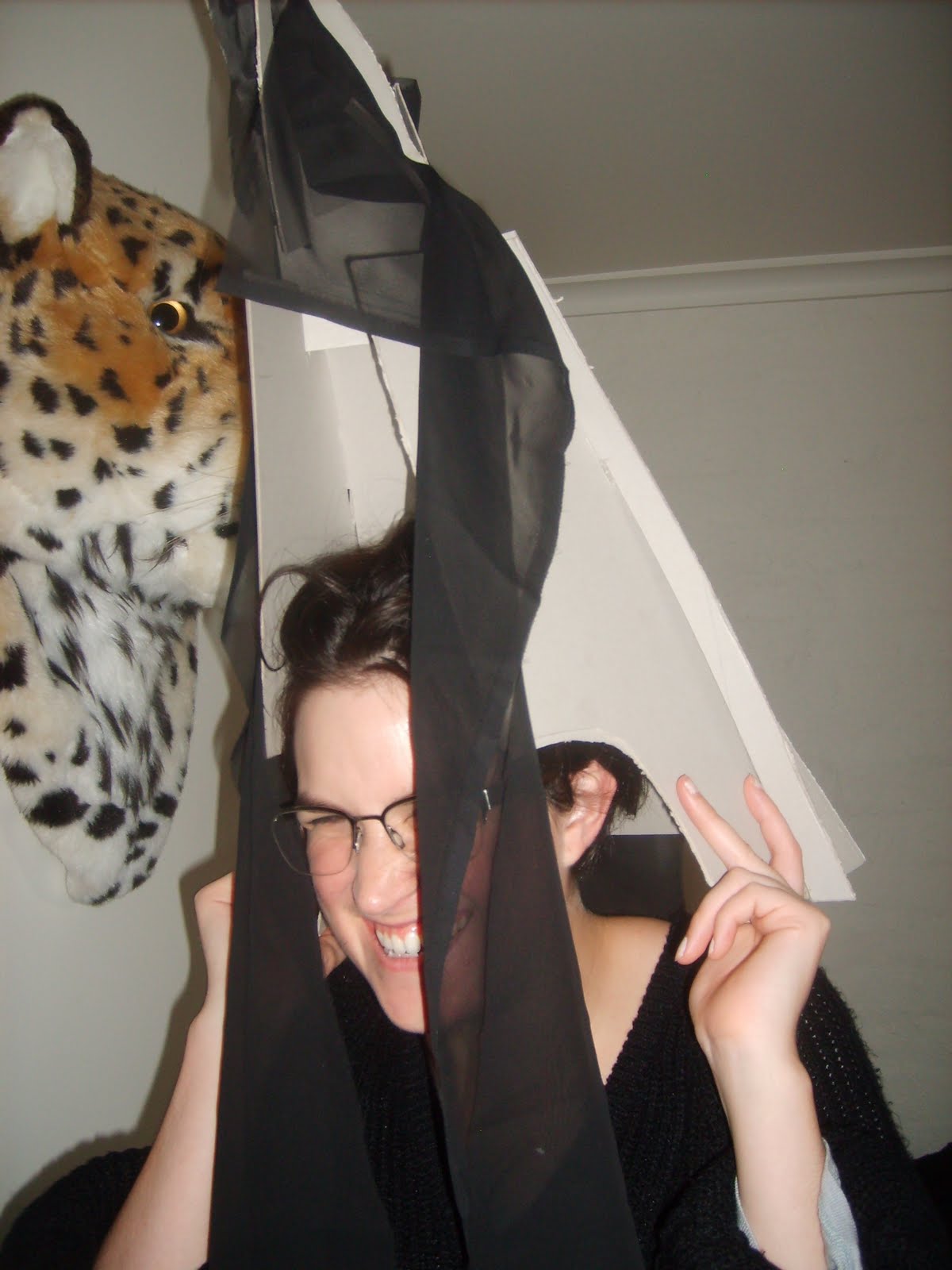
I always find how Dianne Perent only wears her black veil outfit, intriguing. Can I pattern-make her veil using the SCRAP - Slit/Slip system? In response to this task I put the outcomes in the context of the blogs initial "Pop Up" and the "Logo", which are both images of Dianne. Images below:


POST FIVE: SCRAP CONEXT

Looking at the 'Scrap' piece in different contexts brings new meanings and developments.

Scrap in the art gallery. Here a folded permutation of scrap is in a gallery space. This is how I imagine it being shown at the moment, though maybe it has existed in previous settings which are re-told at the gallery. The context of the art gallery, is not unlike the context of a garment, as both are places which are a designed environments. In reduction they are also both enclosed spaces although implying different level of scale and social use. I think if I place worn environments within the public environment of a gallery, the transition from personal to public space will be confronted.
Scrap in the cardboard recycling. This is a context relates to the material the object is produced from. As it's made of cardboard, it fits in the package recycling box. I like the idea that a cardboard box can be designed. I like that the use of something which is used as packaging could be applied to the contents. For example if the box folded out to a pattern piece, which was then used to trace onto the required fabric contained in the box.

Scrap as a fence. Scrap in the context of a fence gives it a feeling of borderline, which in a way is what a pattern piece is, or has the intention of being. This also reminds me of earlier images I was looking at in the development and research for Scrap, of works by RON RESCH. Particular a piece where he used his folded paper as an acoustic panel. Pattern Pieces could be used first as a pattern and then slotted together to create an acoustic wall.


Scrap in the garden. I love this one. Cardboard Planters. Pattern Cards having a second use as a decomposable and modular system of potting and growing plants. The slits have a good effect here.


Scrap in Ikea. Here Scrap becomes a flat-pac. It's place denotes ideas surrounding its accessibility and dissemination.


POST FOUR: CONTEXT

THESAURUS
  • conditions, factors, state of affairs, situation, scene, frame of reference, relationship to themes of setting.


DICTIONARY

  • the circumstances that form the setting for an event, statement, or idea, and in terms of which it can be fully understood and assessed.
  • the parts of something that immediately precede and follow something and clarify its meaning
THOUGHTS
  • Context is the circumstances of setting of a thing (object, event, idea etc.) which impact on how the thing is understood and assesses. Context is the surrounds of the thing which bring to it all its associations, and meanings. Everything exists in a context as existence happens in space and time.
  • In some ways I hope my work has as little extraneous context as possible, I hope it’s frame of reference is only in the experience of it, in itself. But then by trying to do this, I know I have just loaded it with massive amounts of conditions which in relationship contextualize this aim.
  • Some points areas of context I would like to look at include, experience, documentation and space

PHOTOS OF MY BRA IN DIFFERENT CONTEXTS


Gives the tree a personality and extra support


a total larry


Gives the bra a sordid teenage setting


thirsty bra


reminds my of henry the eighth

Wednesday, April 27, 2011


POST THREE - QUESTIONS:

My initial questions, and the following breakdowns:
  • How do you document worn fashion space
  • How do you make a person question where space is that they wear
  • How does the boundary of a pattern relate to the negative space of the world and the positive space of wearing or vice versa or each other?
  • How do you construct the notion of self, with the design and wearing of a space?
  • Where does wearing finish in the space of a garment?
  • Where does the boundary of embodiment end in the act of wearing?
  • How do you wear an environment?
  • Can an environment be fashion?


POST TWO- Quotes


Here are some things Im thinking about through the world and words of others.

  • “Dress lies at the margins of the body and marks the boundary between self and other, individual and society. This boundary is intimate and personal since our dress forms the visible envelop of the self and serves as a visual metaphor for identity”

- (Entwistle, J. 2001)

  • “Immense is not an object, a phenomenology of immense would refer directly to our imagining consciousness. In analyzing images of immensity, we should realize within ourselves the pure being of pure imagination. It then becomes clear that works of art are the by-products of the existentialism of the imagining being. In this direction of daydreams of immensity, the real product is consciousness of enlargement. We feel that we have been promoted to the dignity of the admiring being.”

- (Bachelard, G. 1964)


  • “Robbert Morris attempted to sum up the polarity between sculptural and architectural experience by saying that in perceiving an object, one occupies a separate space - ones own space. In perceiving architectural space, ones own space is note separate from what is perceived. In the first case one surrounds, in the second, one is surrounded.”

- (Ran, F. 2009)


  • “For these ports [or garments] I could not draw a route map or set a date for the landing [or wearing]. At times all I need is a brief glimpse, an opening in the midst of an incongruous landscape [of fabric], a glint of lights in the fog, the dialogue of two passers by meeting in a crowd, and I think that, setting out from there, I will put together, piece by piece, the perfect city [or garment], made of fragments mixed with the rest, of instants separated by intervals of signals one send out, not knowing who receives them. If I tell you that the city [of personal space] towards which my journey tends is discontinuous space and time, now scattered, now more condensed, you must not believe the search for it can stop. Perhaps while we speak it is rising, scattered, within the confines of your empire [or body]; you can hunt for it, but only in the way I have said.

- (Calvino, I. 1972)


POST ONE - SCRAP


SCRAP entailed a three week generative studio, taken by MATERIALBYPRODUCT. In this studio we were asked to:


“generate thought and propositions for new ways of dealing with the inevitable waste in the garment making process...Consider the entire length of cloth and cutting ‘both sides of the scissors’ for the invention of new form...[create a series of forms and associated ideas for the transformation of ‘scrap’... re-think of the long term and initiate design supported by asystematic approach for the elimination of scrap currently known.”


What is scrap. Mainly it is a consideration of value in something. Something that looked at as waste, having no use, no longer relevant as a decision of worth. I am concentration on the scrap of the FABRIC and PATTERN CARD.


LEFT OVER FABIRC

  • how can I create pattern cutting in a clean way in which everything is useable.
  • Negatives and Positives have the same level of use in a system of cutting. All cut pieces become integrated by the creating of a SLIT SLIP method of production.
  • Taking reference from flat pacs, an internal slit means fabrics can be slipped into one another and fused or sewn together to create a wearable construction.


LEFT OVER PATTERN CARD

  • Usually in a commercial level of garment production, the pattern card of one style, or multiples of this card depending on how big the company is, will be used as a template to cut garment peices. They are then discarded with one being archived. Thier archiving includies being stacked up together, placed on a pattern hook and occupying some small space on a rack somewhere in a studio
  • How can the Pattern Card become a by product, where in folling the seam slit/slip method of construction as its fabirc permutation (garments) becomes a phenomenal sculpture.
  • As a sculpture it may both, reveal process, and create a new experience of worn space by challenging assumed documentation of form.


OUTCOME


A flat pac documentation of a pattern and garment making process. Intended to be used as information resulting in two permutations of the one form.


  1. Pattern cards are used to trace of fabric pieces and the construction method to make a garment
  2. And then use the pattern card themselves and construction method to create a sculptural form.


THINGS taken from Scrap


In thinking about things developed in Scrap which I would like to carry over into pre major project a few major concerns and techniques stand out.


I want to further explore the use of pattern card and ability to have a second-use as something else. This could be something between fashion, architecture, art and product. How can you further explore the template of a garment, perhaps off the body, how can you have a further experience of the space you take up in a form of walls? I think the way we document a space in card-board through the pattern could be challenged. Why do we approach it in the way we do and what other ways could the looked at?


I like the ‘slit/slip’ technique. I like the way in which it in a way eliminates seams, in that the over edge is extended and possible inside/outside fillings and hollows of garments become increased. How can this way of construction become more resolved in applying to garments and a form, how can it be more dynamic in what it creates. Also how can it be refined as a process that is applied to any garment, style, object of form. Maybe also, how can it be used to create more of an environment?


MBP have always had a major interest in positive/negative of the garment in pattern cutting and wearing of form. I like this in how we experience a garment. Want to take an element of this notion into what I produce, and further how it gives the viewer/wearer an understanding of how they experience inside and outside.