Saturday, May 22, 2010

FILM and PROJECTION test ONE
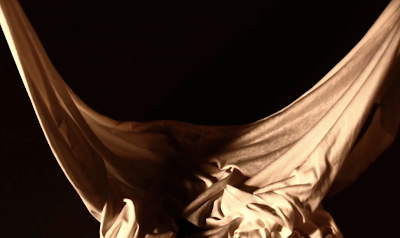
FILMING TEST ONEDoff and I experimenting with lighting in which to best pick up impression of folds.

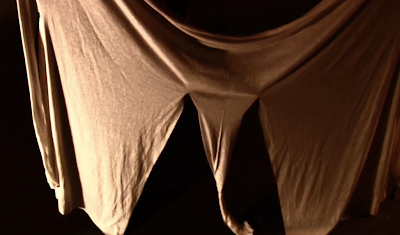
Ended up making 3 short clips from the footage. The first used methods of draping half scale of jacket on floor with the filming of its folds then being unfolded. Expansion and retraction of a fabric wall. Stills of film below:
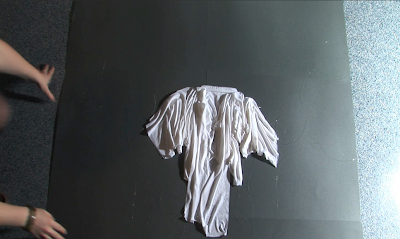
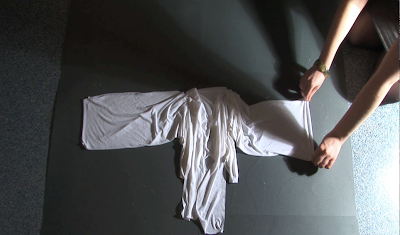


If Im looking at how fold create space, does it matter if they're ordered? I wondered and doubted this. So this is just a random fabric throw.
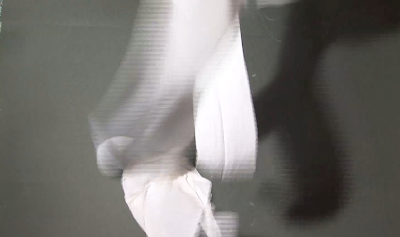


Doff suggested stringing up the cloth and him panning the camera upwards as I pulled its form out flat. We also muddled with the contrast - maybe this will project better, when its projected.

Monday, May 17, 2010
The PHENOMENOLOGY of PROJECTION
“The visible about us seems to rest in itslef. It is as though our vision were formed in the heart of the visible, or as though there were between it and us an intimacy as close as between the sea and the strand. And yet it is not possible that we blend into it, nor that it passes into us, for then the vision would vanish at the moment of formation, by disappearance of the seer or of the visible. What there is then are not things first identical with themselves, which would then offer themselves to the seer, nor is there a seer who if first empty and who, afterward, would open than by palpating it with our look, things we could not dream of seeing “all naked” because the gaze itself envelops them, clothes them with its own flesh.” MMP, The Visible and the Invisible, pg 130-131
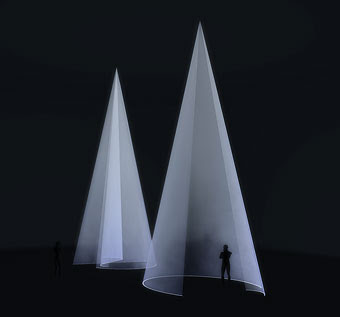
How do you experience wear? Can you wear light? I have been looking at methods of projection in modes of exhibiting. Maybe using projection of forms, animation of drape. Last weekend I went to the Screen World Exhibition at ACMI. It was mostly non-engaging. Except for one magical room, displaying a work by Anthony McCall.

My Experience of the Work:
On entering I came to a heavy dark curtain, which I proceeded past to a dark room. On entering the room, it took a while for my eyes to adjust and get a sense of space in the darkness. On one side of the room, two curved lines of light were slowly moving past and amongst each other. On the opposite wall, I realized their origin of their projection. A smoke machine created dust particles in the dead air space between these two sides meaning the traveling light was picked up and given a matter for retention.
At first I instinctually found myself moving away from the lines when they approached me. I tried to place my body within the alcoves of the light walls. I had a heightened awareness of the two sides of each line. The length of their projection made me more aware of the space of the overall room, and the moving possibilities of the way the curved lines cut and segmented it.
Quite literally, I was wearing the light, and the boundaries of this wearing were changing.
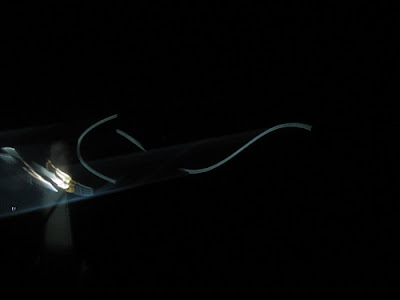
I have been thinking a lot about materiality. Can I form drape with something other than fabric. Can a curtain or a wall be transparent in the way it delineates space and creates a form. I think this Merleau-Ponty quote is interesting in thinking about, and can be applied to McCall’s instillation, “The completed object is translucent, being shot through from all sides by an infinite number of presented scrutinies which intersect in its depths leaving nothing hidden.”
Light it translucent and therefore the way it creates a form is transparent in a way. Nothing is hidden when you look at it - everything is knowable. However, there is still something which has to pick up the light - smoke particles, a wall, a curtain, a garment?
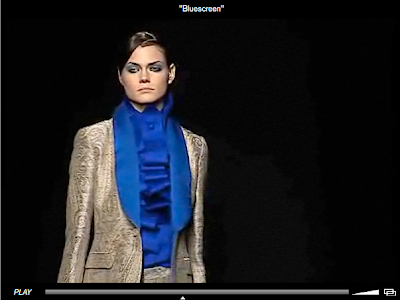
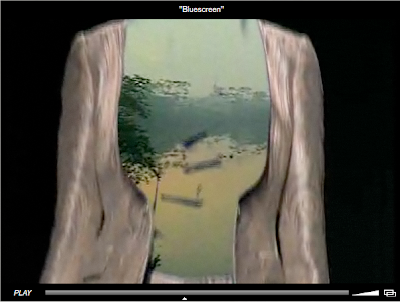
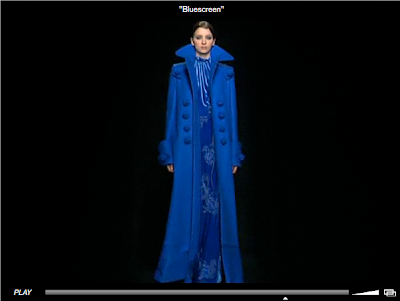
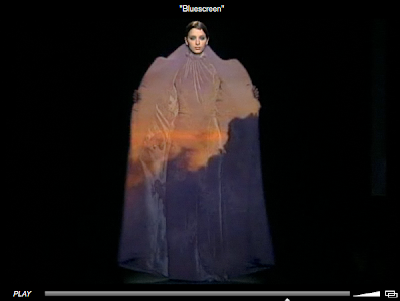
Viktor and Rolf’s ‘Bluescreen’ collection also uses projection. In this collection parts of their garments are fabricated in Blue which has the ability to digitally pick up projection. In looking at their catwalk - the retention of a 2D image on a 3D form is really interesting. Merleau-Ponty talks about how the screen has no horizons. The image of a filmed object become in a way flattened and 2D, when projected onto a form. For example the way the gathered neckline of the dress.
Here are a couple more crucial images in building up this projection feeling. The first is of a Galliano dress in which an air brushed image if drapery is superimposed on a dress which is also draped in some areas. It also, to an extent, gives you a sense of fit - in that the image os of loose folds, but the actual garment is so glove-fitting.

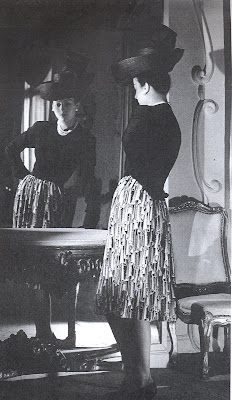
The second image is a Balenciaga skirt, in which the fabric is printed with loose flutes of drape.
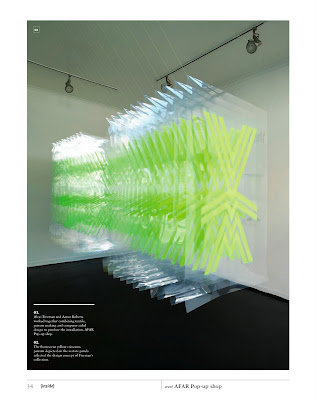
I've also been looking at ways to rigging up transparencies. Much like the AFAR Project, shows at Off The Kerb Gallery late last year - a collaboration between Alexi Freeman and Aaron Roberts from Room 11 studio. The Project uses one of Freeman's print patterns on repeated hanging transparencies. I like the idea of superimposition which if viewable from multiple angles. The pattern is of a scale which relates to the body, thus the instillation can be worn by it's viewer. I'd like to do some experimenting with still shots of drape or garments in this form. Perhaps again layering this with projection.
Theme of the week - translucency. I think I need to be relating it more to experience though.
Sunday, May 9, 2010
The SYDnificance

I have returned from Sydney. The week was spent attending RAFW shows, finding interesting nooks, places and people in Sydney, observing what Sydney had to offer me in the way of fashion and further ways of showing/communicating fashion. Constantly throughout the whole experience everything we saw and did triggered the voice in my head to think 'how will I appropriately show and display my work?' I actually didn't take that many photos throughout the week, but here are some of the ones I did take with some verbal unravellings in this post:
Observing Australian Fashion Week taught me many things. From viewing a number of shows it is easy to see that they are more about production than content. When exiting upon a Fashion Show people talked amongst themselves about the look of the show. They commented on the effect of extraneous trivialities like hair, music and shoes. I don't blame them and I myself found this unavoidable when watching a show. During the parades I found myself distracted from the actual clothes by the phenomena of its staging, and I kept on having to remind myself to look at the garments. I never left a show feeling significantly impacted by the way the garments used space or the body in communication. I understand that every form of fashion has its own place in the spectrum with appropriateness to its content and intention. However I strongly question weather I would ever want to be a part of a catwalk fashion show in any way, ever. Though I do completely value garments being viewed and experienced on a fleshy body, maybe this is the participants body though? How does this body have a dynamic, challenging and unassuming relationship with the space around it through fashion?
On Tuesday I went to a talk by Philip Fimmano, assistant to Li Edelkoort of TREND UNION. I had seen Mr. Fimmano talk at on of the Victoria Design Festivals in (I think) 2005, so it was interesting to see how the trend presentations that they compile and develop had changed in five years. Their image prenetations make use of a 'double page' - a split screen combining two images, which I really find effective. Fimmano talked of 'iconographic research' which is something I think a lot of people, including myself, do in development and the power of these images as a standpoint when words become to oversewn. He also kept of referring to how many people who work for TREND UNION have a heightened sense of intuition and how really trend forecasting is based on creative intuition. Fimmano said that, "everything we do is an application of intuition and reason. We follow intuition to its end and then put this into practice with pragmatics." This is similar to how we develop our studio work. Research, feelings and intuition - and now is the time to start being pragmatic, testing and editing. I struggle with intuition and knowing it.
After this presentation on Tuesday I had a kick around UTS and hit up their library, which has a lot more books that RMIT, it was pretty awesome. On a wall of a building next to the library was this circular window with clothes inside behind the glass. Nice use of space, transparency, looking and garments.


On Wednesday night we went to the Romance was Born show at Sydney Uni. The most thrilling thing about the show was the shenanigans of sneaking in. They had one of those inflatable halogen lights above the catwalk, as it was held in a dark hall. I like these.

We went to the Art Gallery of NSW and walked though Hyde Park on the way home. Here a some pictures of a street performer blowing huge bubbles. They were beautiful and transparent.


On Thursday morning we went to Gaffa Gallery, a gallery for emerging and intependent artists, with studio spaces available upstairs. When we visited, they were holding the fourth series of thier MAKE exhibtion - showing artworks by artists who have worked for Object Galley - another gallery in Sydney. In the exhibit were works by a man named Stephen Goddard, who from what I can gather from internet stalking is a photographer/graphic designer. He has a consultancy business - Stephen Goddard Design. His two works at Gaffa were effective and beautiful.


He uses the shape of text as an overlay and also to take the form of a cutting line of a garment layer. I like the use of a cut associated with questioning words, as cutting is a form of asking questions and unveiling.
Friday arvo we went to the Centre for Contemporary Photography. This pic is by Mark Greenland.

At the begining of the week I was really hating the idea of going to sydney and having one less week to do work. But I think it has done some good, in having some time of less intensity and slight separateness from studio work. I know the next draft of my skeleton/proposal will be different as a result of the things I have seen.
Subscribe to:
Posts (Atom)